
SimplexNoise: a small C++ Simplex noise library
I read a series of articles on LinuxFr about Perlin noise for map generation, that triggered me to implement my own procedural-generation experiments: terrain heightmaps, textures, that sort of thing. I wanted something I could drop straight into a C++ project, so I ported Simplex noise from a Java reference implementation and put it on GitHub as SimplexNoise.
Simplex noise is the gradient noise Ken Perlin introduced in 2001 as a successor to his classic noise from the 1980s. The win is mostly about dimensions. Classic gradient noise samples a hypercube, so in n dimensions it has to interpolate across its 2ⁿ corners. Simplex noise samples the simplest shape that fills the space instead, which has only n+1 corners: a triangle in 2D, a tetrahedron in 3D. The cost then grows roughly like n² rather than 2ⁿ, with fewer visible directional artifacts as a bonus. The LinuxFr article that set me off puts it plainly:
Le bruit à base de simplexe est une évolution du bruit à base de gradient et proposé par le même Ken Perlin. Le problème du bruit à base de gradient est qu’il requiert O(2ⁿ) interpolation pour un bruit à n dimensions. Ceci vient du fait qu’on utilise un hypercube qui a 2ⁿ sommets. Pour avoir moins de points, on va utiliser un objet à n dimensions qui possède le moins de points possible : c’est ce qu’on appelle un simplexe. En dimension 2, c’est un triangle. En dimension 3, c’est un tétraèdre.
I did not reinvent any of that. For the maths I leaned entirely on Stefan Gustavson’s “Simplex noise demystified” (2005) and his 2012 speed-improved Java reference, with a few optimizations credited to Peter Eastman. I only focused on the C++ port and sharing it.
The API is simple: a single SimplexNoise class with noise() overloads for
1D, 2D and 3D, plus a fractal helper that sums several octaves of noise (fractional
Brownian motion) with configurable frequency, amplitude, lacunarity and persistence. That
fractal summation is what turns a single smooth noise field into something that reads as
natural detail. It is the family of noise behind a lot of game terrain: the same article
points out that Minecraft builds its worlds « à base de bruit de Perlin ».
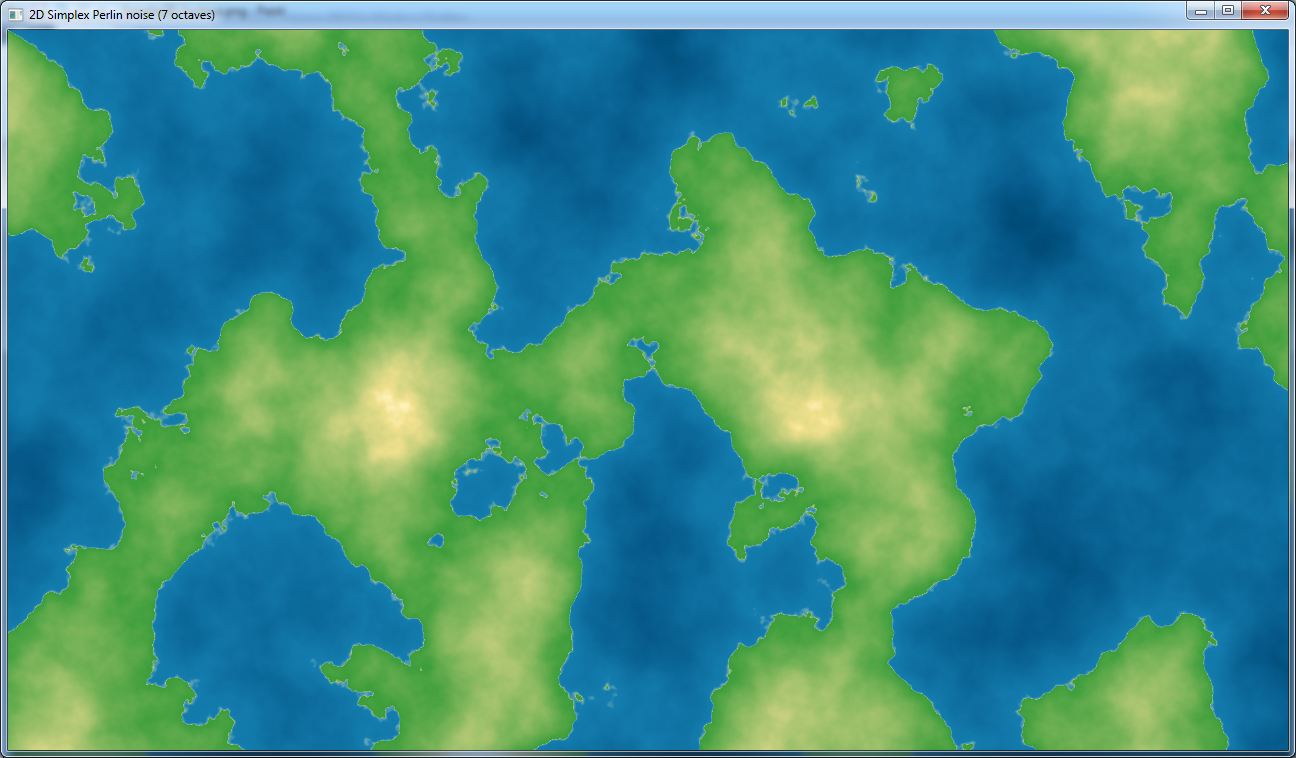
Here is 2D fractal noise with 7 octaves, rendered with a small companion example that draws the field with the CImg library:
The repository follow my usual template: MIT licensed, small library with just a header and
a source file, a CMake build, cpplint and cppcheck wired in for style and sanity, a
Doxygen config for the docs, and continuous integration on both Travis CI (Linux) and
AppVeyor (Windows).
Code, examples and the Java reference are on GitHub: github.com/SRombauts/SimplexNoise. Feedback and pull requests welcome.
Further reading
- The article that got me started: Je crée mon jeu vidéo E10: génération procédurale de carte on LinuxFr, and its part 2.
- Stefan Gustavson, Simplex noise demystified (2005), the PDF and Java code I ported from.
- Jérémy Cochoy, Introduction au bruit de Perlin, a French walk-through of Perlin and simplex noise.
note: 1
-
Written retrospectively in 2026 while documenting a few older projects that never got their own post (the repository went up in August 2014). ↩